


Aviator Game Guide: Reading the Multiplier
Aviator is a crash game developed by Spribe, a studio founded in August 2018 in Tbilisi, Georgia. The game launched in January 2019 and first went live on Adjarabet in February 2019. Each round shows a plane climbing a rising curve while a multiplier counts up from 1.00x, and that curve can crash at any moment.
This guide explains how the multiplier behaves, what the published probabilities say about each level, and how to time an exit with manual or auto cash-out. It stays with the mechanism, the numbers and one worked example, because in Aviator the math is the whole game.
How the Aviator multiplier works
Aviator is a crash game, not a slot, and it has no reels or bonus round. Spribe describes it as a “social multiplayer game consisting of an increasing curve that can crash anytime”, which is an accurate one-line summary of the mechanic.
Each round follows the same short sequence:
- Players place one or two bets in a short window before take-off.
- The plane lifts off and the multiplier starts climbing from 1.00x.
- The curve rises quickly at first and flattens as the multiplier grows.
- At a point fixed before take-off, the plane flies away and the round crashes.
- Players still in the round lose the stake; players who exited keep stake times multiplier.
Rounds last about 8 to 30 seconds with a few seconds between them, so an operator typically runs 60 to 90 rounds per hour. Aviator 2.0, released on 15 August 2019, made the game 40% faster and lighter for slow connections and low-end phones, which matters when your exit depends on timing.
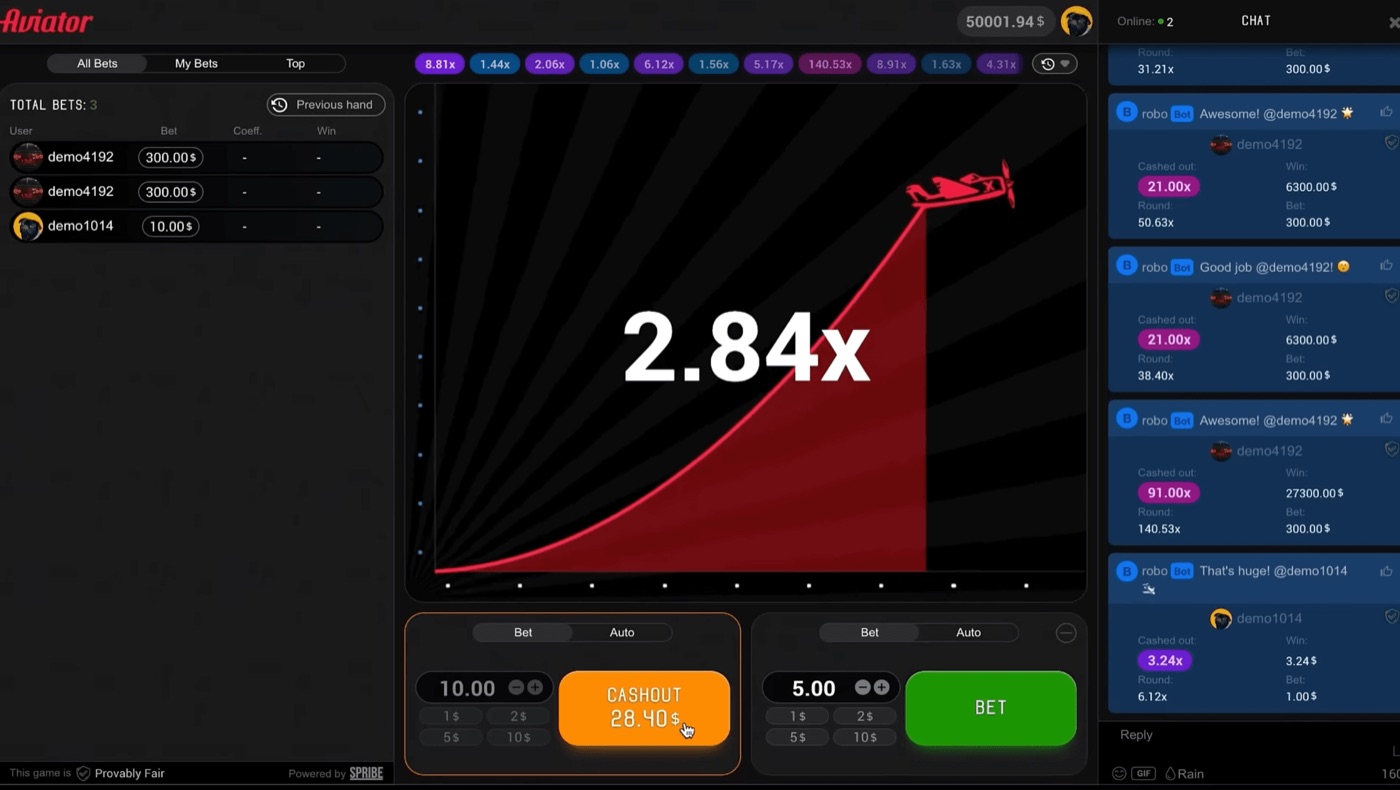
The Aviator interface: rising curve, live bets panel, chat and a cash-out recorded at 28.40x.
The payout formula is one line: stake multiplied by the multiplier shown when your cash-out reaches the server. A $1 stake closed at 2.00x returns $2; the same stake closed at 10.00x returns $10. Everything else in the game is about when that closing moment happens.
Multiplier probabilities in numbers
Aviator runs at a 97% RTP, which leaves a 3% house edge. The probability that a round reaches a given multiplier m is 0.97 divided by m, and that single formula drives every timing decision in the game.
The table shows what the formula produces at common cash-out levels.
| Target multiplier | Chance the round reaches it |
|---|---|
| 1.2x | 80.8% |
| 1.5x | 64.7% |
| 2x | 48.5% |
| 3x | 32.3% |
| 5x | 19.4% |
| 10x | 9.7% |
| 20x | 4.85% |
| 50x | 1.94% |
| 100x | 0.97% |
Three points follow directly from the math:
- About 3% of rounds, roughly 1 in 33, crash instantly at 1.00x and pay nothing.
- Expected value is -3% of the stake at every cash-out target, so no target beats the edge.
- Strategy changes variance, meaning how swingy the results feel, not the long-run return.
Aviator is a high-variance game. A target of 1.5x lands in 64.7% of rounds, while a 10x target lands in only 9.7%. Reading the multiplier means accepting this trade-off: low exits hit often and pay little, high exits hit rarely and pay more.
Choosing when to exit
The cash-out button is the only decision a player controls during an Aviator round. With rounds of 8 to 30 seconds, the exit window at low multipliers lasts only a few seconds, so the choice has to be made before take-off.
Guides that cover exit timing tend to converge on the same working ranges:
- Manual exits at 1.3x to 1.5x succeed in roughly 65 to 75% of rounds.
- Auto exits at 1.5x to 2x balance hit rate against payout size.
- Long targets of 5x to 50x are realistic but land in a small minority of rounds.
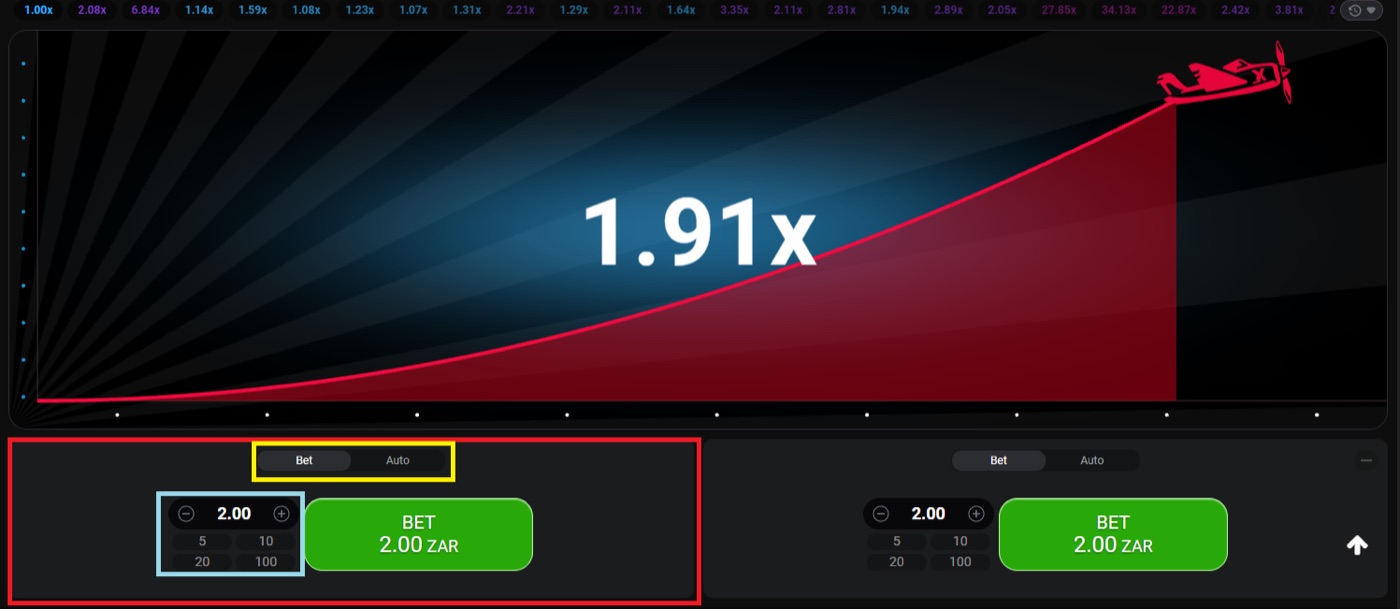
A desktop round climbing through 1.91x, inside the common 1.3x to 2x exit range.
Players comparing where to apply these cash-out targets may come across pages such as aviator casino delano, but the multiplier curve and its probabilities stay identical at every bookmaker. Stake limits differ: typical stakes run from about $0.10 to $100 per bet, and the exact range depends on the operator.
Timing also has a technical side. The cash-out request must reach the game server before the crash point arrives; if it arrives after, the bet is lost. Complaints about a cash-out that “timed out” usually trace back to connection latency or a slow device, not to the round itself.
Auto cash-out and auto play
Auto Cash-Out closes a bet at a preset multiplier without a manual click. The Auto tab on each bet panel also runs Auto Bet for 10 to 100 rounds, with stop-on-win and stop-on-loss limits.
The automation settings break down as follows:
- Auto Cash-Out: exit at a fixed multiplier set before take-off.
- Auto Bet: repeat the same stake for 10 to 100 consecutive rounds.
- Stop conditions: halt the sequence at a chosen win or loss amount.
- Per-panel control: each of the two panels carries its own stake and exit value.
The practical benefit is consistency. An auto exit at 1.5x fires at exactly 1.5x in every round it survives, while a manual click can be late by a fraction of a second. Over 60 to 90 rounds per hour, small delays add up, and automation removes reaction time from the equation entirely.
Automation does not change the odds, though. A 1.5x auto exit still wins 64.7% of rounds and still carries the same -3% expected value as a manual exit at the same level.
Two-bet split and bankroll rules
Every Aviator round offers two bet panels, each with its own stake and cash-out. Strategy guides use this layout for a two-bet split, where one bet exits early and the other rides toward a bigger multiplier.
- Safe bet: auto cash-out at 1.5x to 2x, sized to recover both stakes when it lands.
- Rider bet: left open toward 5x to 10x for larger but rarer returns.
- Staking: no more than 2% of the bankroll on a single round.
- Session limits: fixed loss and win limits set before the first bet.
- Practice: start in demo mode, which needs no registration.
A worked example with a $100 bankroll: 2% means $2 total per round, split as $1 per panel. Panel A auto-exits at 1.5x and returns $1.50 when the round gets there. Panel B rides toward 5x and returns $5 only if the round reaches it. If the round crashes at 1.00x, which happens about 1 time in 33, both panels lose.
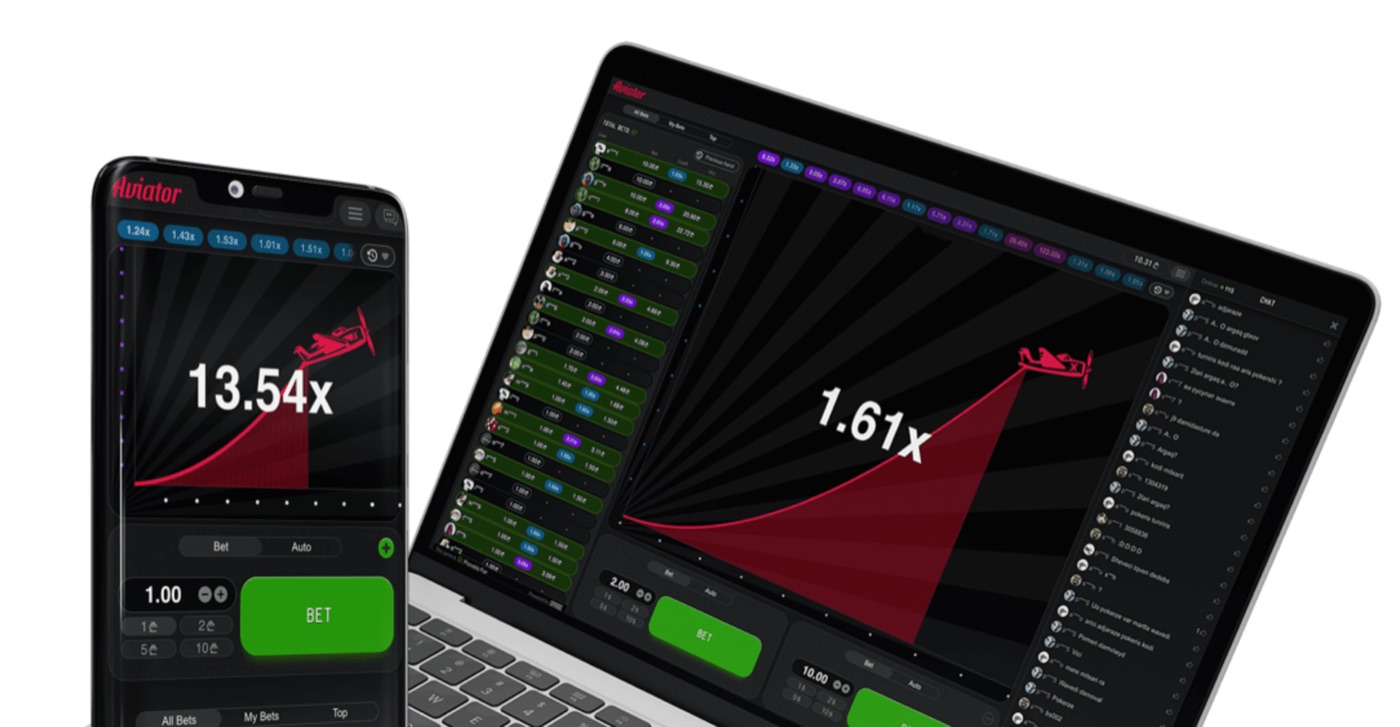
The same account on two devices: 13.54x on the phone and 1.61x on the laptop.
Big exits do happen. On 10 April 2024, a Hollywoodbets player won a record R10,000,000 from two bets, R1,400 at 3571.42x and R1,600 at 3125x. Spribe does not publish a maximum multiplier, and win caps per round are set by each operator, so the ceiling depends on the operator.
Progression systems do not beat this math. Martingale doubles the stake after each loss and reaches 1,024 times the base stake after 10 straight losses; Fibonacci and D’Alembert fail against the 3% edge too. Set a budget you can afford to lose and treat the game as paid entertainment, never as income.
Why patterns and predictors fail
Aviator fixes its crash point before the plane takes off. Before each round the server publishes a SHA-256 hash of the server seed, and client seeds from players are combined into the result.
After the round, the inputs are revealed and can be checked with the verification tool inside the game. Neither the operator nor Spribe can change a result once the round starts. Because the outcome is committed by hash in advance, nothing can read it beforehand:
- “Aviator Predictor” apps on Google Play, Softonic, Uptodown and APK mirrors are third-party clones, not Spribe products.
- Version names such as “Predictor v4.0”, “v8” or “v12” are marketing labels, not tools.
- Telegram signal bots resell probability math that is already public.
- The round-history strip shows past multipliers; rounds are independent, so it is not a forecast.
Hollywoodbets tells its players not to spend money on Aviator predictors, and the provably fair design is the reason that advice is sound. There is also no standalone official Aviator app from Spribe: the game runs inside a licensed operator’s website or app.
Aviator FAQ
What is a good multiplier to cash out at in Aviator?
Most guides suggest 1.5x to 2x. The round reaches 1.5x in 64.7% of cases and 2x in 48.5%. Expected value is -3% at every target, so the choice sets variance, not profit.
Does auto cash-out change the odds?
No. Auto cash-out removes reaction delay, nothing more. The 0.97/m probabilities and the 3% house edge apply identically to manual and automatic exits.
Why did my Aviator cash-out time out?
The cash-out request must reach the server before the crash. Time-outs usually come from connection latency or a slow device. Aviator 2.0 was built lighter for slow connections, and a stable connection reduces failed exits.
Can an app predict the Aviator multiplier?
No. The crash point is committed by a SHA-256 hash before the round begins, so prediction is impossible. Apps and bots claiming to predict results are third-party clones or resellers of public math.
Can I practise reading the multiplier for free?
Yes. A demo mode exists through operator demos and demo.spribe.io, needs no registration, and runs on desktop, tablet and mobile browsers. The demo uses the same curve, so timing practice transfers to real play.